


“There is an island in the midst of the wine colored sea, beautiful Crete…”

Greece is one of oldest wine-producing countries. The first mention of this drink refers to the Minoan age, and exactly Crete was the center of the wine production. Optimal climatic conditions and long tradition of viticulture allow also today that Greek wines occupy leader lines in the world ranking. Let’s try to understand, what wine we have to uncork first.
The most delicious legend of Crete
According to a Greek legend, the discovery of the vine belongs to a shepherd named Staphulinus. He gathered some fruit, unknown to anyone at the time, and carried to Oinos, his master. The latter brought them to Dionysus as a gift, and the god taught Oinos winemaking as a reward.
The scientists hold the view that the traces of wild grape, found in Crete, belong to the ice age. Fossilized grape seeds and pulp (remains of pressed berries) have allowed us to conclude that the first appearance of cultivated grapes dates back to the second half of the V millennium BC. Grapes were the main products of agriculture on the island in the era of king Minos, which is considered to be the period of greatest prosperity of Crete, and the wine was the main object of export.
The world’s most ancient winepress was found again on Crete as well as traces of wine in special vessels, dating from even earlier periods. Press for grape juice and clay tablets with enumeration of agricultural commodities including wine, which were stored in warehouses of the royal palaces of Knossos, belong to the Mycenaean period (1100-1000 BC).
The first written evidences of Greek wine are mentioned in the heroic epics of Homer, in his “Iliad” and “Odyssey”. In the VI century BC, Greek wines are becoming more and more recognizable and popular. In this era, “wine” coins with symbols of Viticulture and Wine have been introduced into circulation.

Tradition of wine consume
Wine drinking was always accompanied by certain rituals. First, all drank a little unmixed wine in honor of the god of wine and winemaking Dionysus, and then poured a little wine on the floor, devoting it to their favorite deity. Thereafter, they brought craters – large bowls with two handles, where the wine was mixed with cold spring water at the rate of 1 part wine and 3 parts water. Mixing equal parts by volume of the lot was considered by them as a habitude of drunkards. For Cretans wine and customs, associated with its use, have always served as a criterion of civilized person. A moderate and tasteful wine drinking in a good company with obligatory toasts “To your health!” still remains now a sign of the high level of culture.
Wine production is nowadays just as significant economic sector of Crete, as it had been in the era of Minos, and Cretan winemakers are as fanatically devoted to their profession. Since late August, here comes the grape harvest (in Greek it’s called “trigos”) – the largest agricultural feast on the island. Guests have the opportunity not only to participate in agricultural work, but also to feel the way of life and traditional culture of the Cretans. In the mountain villages of Crete with strong tradition, a day off is reserved for the “Trigos”. All the resident including schoolchildren go to the grape harvest and then trampled it turning in mustos which later turns into wine. By the way, one can see golden particles in a glass with mustos, raising it to the sunlight.
By tradition, the first wine tasting is held on the day of St. Demetrius, October 26 or November 3, the day of St. George the Drunkard. Locals are dipped in a fun and laid-back atmosphere of the holiday, the protagonists of which are wine, feast, dance and pleasant conversations.
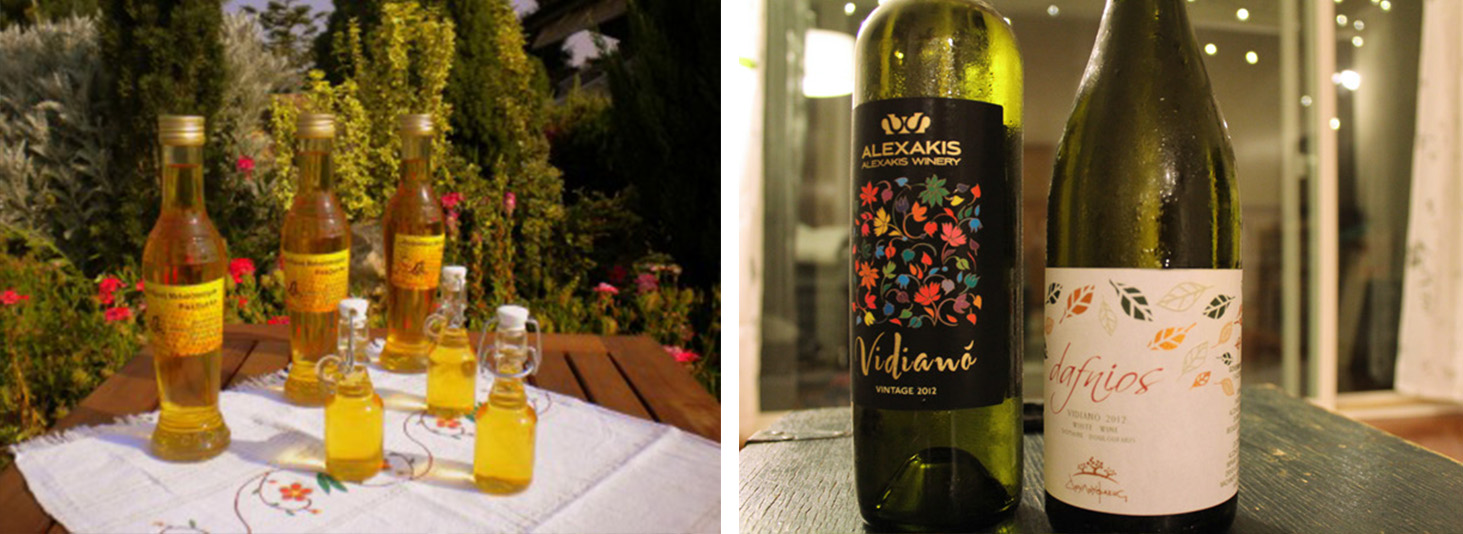
Fifty shades of red and even pink, and then white
Crete produces about a fifth of all Greek wines, approximately 950 000 hectoliters per year. On Crete, vineyards cover an area of about 50 000 hectares. The island has four wine regions (appelations): Peza, Sitia, Archanes and Dafnes. The Peza gives about 70 % of wine, produced on Crete. There are mainly dry white and red wines. The Archanes are famous by their dry red, and the Dafnes and Sitia produce only red wines.
The most popular varieties of red wines are “Vilana”, “Liatiko”, “Kotsifali” and “Mantilari”. Among white grapes are worth noting a very promising “Vidiano”, specific “Plyto” and “Thrapsathiri” as well as fragrant “Dafni” and “Malvazia di Candia”.
Dry Cretan wines often have soft and bright notes of acidity and mineralization. Only white wines can be tasted in their purest form; red wines are usually blended. This allows us to achieve a deeper color and diversity of tastes. Cretan oenologists (specialists in wine production) are constantly experimenting with varieties and flavors in order to achieve results which will satisfy even the most discerning connoisseurs of wines.
Driving through villages, during a self-journey, be sure to pay attention to some simple written advertising such as “Wine tasting” or “Winery” of sellers of home-made wine, which is filled in glass bottles and plugged securely, so you can take it as well as a souvenir. If you have came to Crete with friends so it is better to buy a canister in a tavern in order to save costs. A very tasty wine is being sold in the monastery of Agia Triada located on one of the rocks in Meteora. You can also buy here high-quality first pressed olive oil and olive soap, made there as well as herbs and local honey with very large discounts. If you go on a tour of the Boutary winery, you can choose there after a wine-tasting your favorite wine. By the way, the wine at the winery will cost much cheaper. Do not by it in the tourist shops, as even the supermarkets prices are significantly lower. The most famous and popular wine distillery are Douloufakis, Minos, Boutari and Lyrarakis. Special wine and culinary tours are held here for tourists. They will tell you about the history of the winery, will show the production process and, of course, will offer taste tests. Do not be surprised if during the taste tests you will be treated to a plate of dates – a benevolent attitude and hospitality run in locals’ blood.
January, 2017
«Retsina» (resin – translation) – a unique wine. It’s called a Greek people’s wine – production in other countries is prohibited. While pine resin is added in wine during fermentation, it acquires an unusual flavor and incredible healing properties. It is particularly useful in cases of stomach and heart diseases.
“Tsikoudia” (Τσικουδιά) or “firewater” is a Cretan alcoholic beverage better known as Raki. The difference is that only the Tsikoudia is produced from peel and stems of grapes but a raki can be made from apples, plums and cherries. It contains 40% alcohol by volume.
It were Cretans and not Italians, as is commonly believed, who started consuming diluted wine as a tradition. It is believed that this custom originated from a desire to reduce its strength. In fact, Cretans dried grapes in the course of preparation of wine and added honey. The procedure allowed them to remove excess moisture from berries while maintaining a high level of sugar content. The wine turned sweet, fragrant and thick, and therefore they diluted it.
Notes
Plato established the basic rules of wine drinking in the V century BC, in particular he defined the prohibition to use this drink up to the age of 18. But people older than forty years could drink as much as they want “in order to alleviate hardships of old age”.
Moustos is a fresh grape juice. It is stored in large wooden barrels which have been cleaned and tarred, as well as prewashed with a special collection of aromatic mountain herbs.
Retsina being an aperitif is served before a meal. Uzo is a digestif.
“levkos inos” – white wine;
“kokinos inos” – red wine.
If you want a bottle of good wine you need to visit “inopolio” (wine shops).
“krasi” – commonly used word for wine in the modern Greek language;
“stiniy’yamas” – a traditional Cretan toast “For our health!”;
“Vilana” – a white wine with a strong flavor of citrus;
“Vidiano” – a white wine with rich fruity notes, beginning from a lime to apricot;
“Mantilari” and “Kotsifali” – a red wine with saturated aromas of laurel, ripe fruit and low alcohol content;
“Liatiko” – a soft red wine with floral and spicy flavors;
“Dafnes” – a wine having rich aroma of prunes and raisins with an intriguing hint of coffee grounds;
“Nihteri” – a strong white wine from unripe grapes;
“Vinsanto” – a sweet red wine from slightly dried grapes.